

You’ve cleaned up your diet, cut dairy for a while, maybe tried gluten-free, maybe not. You’ve had blood tests that came back “normal”. Yet the bloating still arrives by afternoon, the headaches keep circling back, your skin flares without warning, and you’re left trying to work out whether dinner was the problem or whether it was something you ate two days ago.
That’s the point where many people start looking up igg food sensitivity test australia and wondering whether it’s useful, overhyped, or somewhere in between. Fair question.
Food reactions aren’t all the same. Some are immediate, obvious, and potentially dangerous. Others are slower, less predictable, and much harder to connect to a single meal. In practice, that’s why people get stuck. They know food seems involved, but they can’t see the pattern clearly enough to act on it with confidence.
A careful IgG food sensitivity test can be one tool in that process. Not a magic diagnosis. Not a replacement for proper allergy assessment. But in the right context, it can help guide a more structured elimination and reintroduction plan.
The Search for Answers to Chronic Symptoms
A common pattern goes like this. Someone feels unwell often enough that it starts shaping daily life, but not dramatically enough to trigger a clear diagnosis. They’re not rushing to emergency with an acute allergy reaction. They’re dealing with a different problem. Ongoing gut discomfort, foggy thinking, headaches, fatigue, skin irritation, or meals that seem to leave them worse instead of better.
Many have already done what sensible people do first. They’ve seen their GP, ruled out obvious issues, maybe tried standard allergy testing, maybe kept a food diary, maybe removed a few suspect foods on their own. The trouble is that delayed food reactions rarely behave in a neat, obvious way.
You can eat one food on Monday and feel off on Tuesday or Wednesday. By then, it's common to blame the wrong thing.
Why guesswork usually fails
The biggest frustration is timing. If symptoms were immediate every time, food detective work would be much easier. But delayed reactions can blur into everything else going on in your life, including stress, poor sleep, hormones, or an already irritated gut.
That’s why many patients end up in a cycle like this:
- They remove random foods and feel only partly better.
- They reintroduce too quickly and can’t tell what changed.
- They become over-restricted and start eating from a shrinking list.
- They lose confidence because every attempt feels inconsistent.
Chronic symptoms often aren’t a willpower problem. They’re a pattern-recognition problem.
An IgG panel is designed to give another layer of information when that pattern isn’t clear. The practical value isn’t that it names a lifelong “bad food”. The value is that it can help narrow the field and make a structured plan more realistic.
When this kind of test enters the conversation
This is usually the point where an igg food sensitivity test australia search becomes more than curiosity. It becomes a way to ask a better question: if standard allergy testing didn’t explain what’s happening, is there a delayed immune response worth exploring?
That question deserves an honest answer, especially in Australia, where food-related immune issues are common and public interest in intolerance testing is high.
What Is an IgG Food Sensitivity
An IgE food allergy is the fire alarm version of a food reaction. It’s fast, obvious, and can be serious. Symptoms may include hives, swelling, or breathing difficulty, and it needs proper medical diagnosis.
An IgG-related food sensitivity is the slower, murkier version. Think of it more like a leak you don’t notice straight away. The response may build over time, and symptoms can show up much later, which is why people often miss the link.

Allergy, intolerance, and sensitivity are not interchangeable
People use these words loosely, but they don’t mean the same thing. If you want a simple plain-English breakdown, this guide on the difference between food intolerance and allergy is a useful starting point.
In clinic, the distinction matters because the testing pathway changes depending on what you’re investigating. Immediate allergy symptoms need conventional medical assessment. Delayed symptoms often call for a different kind of investigation.
What the test actually measures
An IgG food sensitivity panel measures specific IgG antibodies to foods you’ve been eating. ImuPro’s overview of what IgG testing involves explains this pathway in more detail.
The key point is simple. The test doesn’t diagnose an anaphylactic food allergy. It looks for immune reactivity patterns that may help guide a practitioner-led elimination diet for delayed symptoms.
That distinction matters because IgG antibodies are also a normal part of immune exposure. Their presence alone doesn’t automatically mean a food is harmful. Interpretation is everything.
Why self-identifying trigger foods is so hard
Delayed reactions can show up as:
- Digestive symptoms such as bloating or discomfort after the fact
- Skin changes that seem unrelated to the meal that triggered them
- Headaches or fatigue that appear later and get blamed on stress
- Fluctuating symptoms that make food tracking messy and inconclusive
Practical rule: If a reaction takes hours or even longer to surface, don’t expect your memory alone to identify the trigger reliably.
Testing can be clinically useful. Not because it gives a final verdict on every food, but because it helps organise the investigation.
The Clinical View on IgG Testing in Australia
The Australian conversation around IgG testing is divided, and patients deserve that explained plainly.
On one side, ASCIA, the Australasian Society of Clinical Immunology and Allergy, does not recommend IgG testing for diagnosing food allergy or intolerance. ASCIA’s position is that IgG testing lacks sufficient scientific validation for that purpose, and that increased IgG can reflect normal exposure or tolerance rather than disease, as outlined in its guidance on food allergy testing. That position is echoed by other major allergy bodies internationally.
Why mainstream guidelines reject it
The concern is straightforward. If a test labels commonly eaten foods as “reactive”, patients may end up unnecessarily avoiding a long list of foods. That can create confusion, anxiety around eating, and diets that become too restrictive.
ASCIA instead supports established methods when a true allergy is suspected, including skin prick testing, blood IgE testing, and supervised food challenges. That’s the evidence-based medical pathway for immediate allergy.
Australia has good reason to take allergy diagnosis seriously. The NSW Food Authority notes that food allergy affects 1 in 10 infants and 2 in 100 adults, while up to 25% of the population believe they have a food intolerance, highlighting why demand for food testing is so strong in the first place, even while debate continues around IgG methods, according to the NSW Food Authority overview of allergy and intolerance.
Why practitioners still use it
This is the other side of the discussion. In practice, many integrative GPs, naturopaths, and some dietitians don’t use IgG testing as a stand-alone diagnosis. They use it as a tool to guide a structured elimination diet in people with chronic symptoms where the usual pathways haven’t provided enough clarity.
That distinction changes the conversation. The question stops being “Is this an official allergy test?” and becomes “Can this result help create a more focused trial diet than random guesswork?”
There’s also growing interest in its use for selected gastrointestinal presentations. Discussion around the reliability of IgG food intolerance testing often centres on this gap between formal guidelines and real-world practice. The tension is real. ASCIA does not recommend the test, yet emerging evidence, including a 2025 randomised controlled trial in Gastroenterology, has suggested IgG-guided elimination diets can meaningfully reduce symptoms in some people with mixed or constipation-predominant IBS, as referenced in the same ASCIA-linked discussion above.
The clinical mistake is treating IgG results as absolute truth. The clinical value is using them as one layer of information inside a broader assessment.
A reasonable middle position
A balanced view looks like this:
| Question | Practical answer |
|---|---|
| Does IgG replace allergy testing? | No. |
| Can it diagnose anaphylactic food allergy? | No. |
| Can it help guide a more targeted elimination plan in chronic symptoms? | In some cases, yes. |
| Should results be interpreted in isolation? | No. They need context, symptoms, and follow-up. |
That’s the position I find most useful clinically. Scepticism is appropriate. So is pragmatism.
The ImuPro Test Process From Start to Finish
Once someone decides to proceed, the process should be methodical. Most frustration with food sensitivity testing doesn’t come from the blood draw itself. It comes from poor preparation, poor interpretation, or trying to act on results without a plan.
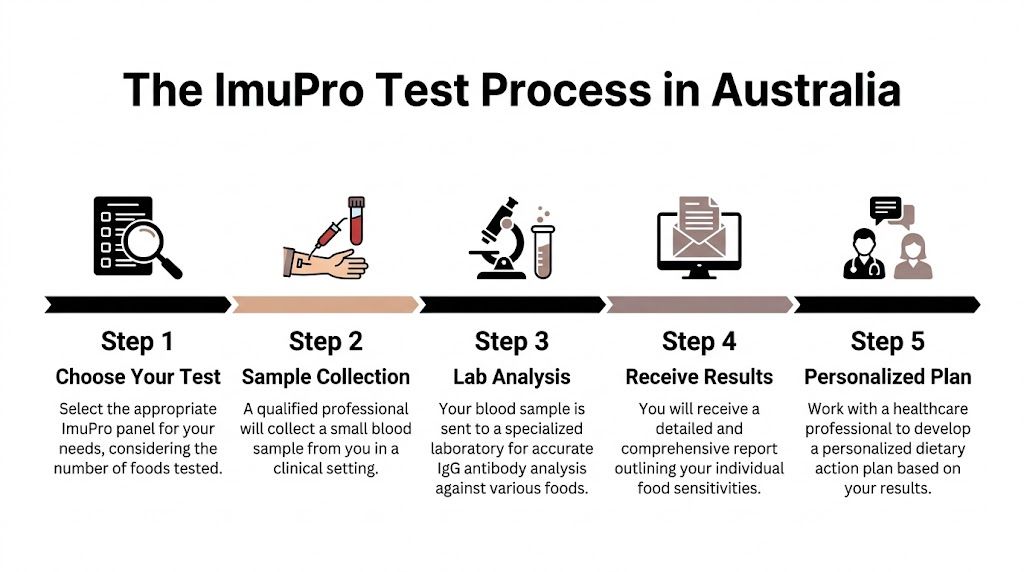
Step by step in real terms
The first decision is the panel. Some people want a smaller screen because they’re looking for a narrower starting point. Others prefer a broader panel because their symptoms are diffuse and they don’t want to miss common dietary staples.
Then comes sample collection. Blood is collected through a local Australian pathology centre, which matters because proper handling and stability are part of getting a usable sample.
Behind the scenes, the sample is analysed using ELISA methodology in ISO-certified laboratories in Germany. Turnaround is typically 10 to 20 days, and that process summary is described in ImuPro Australia’s explanation of its testing method and turnaround.
What arrives at the end
A good report shouldn’t just hand you a list of foods and leave you there. It should help separate lower-level findings from stronger reactivity and support a practical dietary response.
The result is usually most useful when it answers these questions:
- Which foods show no meaningful elevation and can stay in the diet with confidence?
- Which foods are more likely worth removing temporarily as part of a structured plan?
- How broad is the dietary impact and how much support will be needed to keep nutrition adequate?
According to the same ImuPro Australia source, practitioner feedback from AU/NZ clinics reports that targeted elimination diets based on results reduce symptom severity by up to 80% in 70-85% of clients after 4-6 weeks. That figure should be read as practitioner feedback, not as a blanket guarantee for every person.
Where people go wrong
The process looks simple on paper, but there are common mistakes:
- Choosing the biggest panel without a strategy instead of selecting a panel that matches the clinical question.
- Testing while already eating a very restricted diet, which can reduce the usefulness of the result.
- Reading “reactive” as “never eat again”, which is rarely the right interpretation.
- Skipping practitioner support when the report is complex or symptoms are multifactorial.
A food sensitivity test is only as useful as the elimination and reintroduction plan that follows it.
That’s why the test itself is only the middle of the process, not the end.
How to Prepare for Your Test and Read the Results
Test preparation is where accuracy is won or lost. Many people do the opposite of what’s needed. They suspect certain foods, remove them before testing, then book the test hoping it will confirm their suspicions.
That can backfire.

The non-negotiable rule before testing
To avoid false negatives, you need to eat a large variety of foods in the two weeks prior to testing, including foods from the panel you’ve chosen. If you haven’t eaten a food recently, the relevant antibodies may not be present in the blood, which can make the result inaccurate. That preparation requirement, and the contrast with IgE allergy testing, is outlined in NutriPATH’s guidance on IgG food allergy test preparation.
This is one of the biggest differences from conventional allergy testing. IgE tests don’t require the same dietary lead-in. IgG testing does.
If you’ve already been self-eliminating, pause and think before testing. In many cases, it’s better to discuss whether to reintroduce foods first so the test reflects your actual exposure.
How to prepare without making symptoms worse
Preparation doesn’t mean bingeing on foods that clearly trigger severe symptoms. It means being thoughtful and broad where appropriate.
A practical approach looks like this:
- Review the panel first so you know which foods are being assessed.
- Include regularly eaten foods instead of cleaning your diet up right before the test.
- Note any major reactions during those two weeks so they can be interpreted alongside the lab result.
- Ask for guidance if you’ve already removed many foods and aren’t sure how to proceed.
For a plain-English breakdown of report categories, this guide to IgG food sensitivity test results explained is helpful when your results arrive.
Reading the report sensibly
The goal isn’t to panic over every high marker. The goal is to sort foods into practical categories. Some will be low concern. Some may be stronger candidates for a short-term removal trial. Some may need correlation with symptoms before you decide anything.
A short explainer can help if you prefer visual learning:
Don’t treat the report like a permanent ban list. Treat it like a map for a supervised experiment.
That mindset protects both accuracy and food variety.
Your Post-Test Action Plan for Lasting Relief
Results alone don’t change symptoms. What changes symptoms is a plan that’s structured enough to test cause and effect, but flexible enough to keep you nourished and sane.

Phase 1 elimination
Start with the foods that are most likely to be contributing. This phase is temporary. The aim is to reduce exposure to the strongest reactive foods and give symptoms a chance to settle.
Keep the diet broad where possible. That matters because the point isn’t to strip everything back to a handful of “safe” foods. It’s to remove the most relevant items while preserving nutritional adequacy.
Some people do well using a structured elimination meal plan as a framework, then tailoring it to their specific report and symptoms.
Phase 2 provocation
Once symptoms are steadier, foods are reintroduced one at a time. During this process, the test becomes clinically meaningful, because provocation helps confirm whether a reactive food matters for your body in practice.
This stage requires patience. Reintroducing several foods at once defeats the purpose.
A sensible provocation process usually includes:
- One food at a time so any reaction is easier to identify.
- Clear symptom notes covering digestion, skin, headaches, energy, and mood.
- Enough observation time because delayed reactions may not show up immediately.
Phase 3 stabilisation
Longer term, the aim is a sustainable diet, not a permanently restricted one. Foods that clearly aggravate symptoms may need to stay out for a while. Others may come back in rotation once tolerance improves.
That’s where people often need the most support. They can eliminate, but they struggle to rebuild variety confidently.
A useful stabilisation plan should do three things:
| Goal | What it looks like |
|---|---|
| Protect symptom gains | Keep confirmed trigger foods under control |
| Maintain variety | Avoid drifting into an overly narrow diet |
| Support everyday life | Build meals that are realistic for work, family, and routine |
A measured reintroduction process often tells you far more than the lab result alone. The report points you where to look. Your symptom response tells you what matters.
Comparing IgG Tests with Other Health Diagnostics
Not every food-related symptom belongs in an IgG pathway. The best testing choice depends on the pattern of symptoms, the timing, and the question you’re trying to answer.
IgG versus IgE in practical terms
Here’s the cleanest distinction:
| Test type | Best suited to | Reaction pattern |
|---|---|---|
| IgE allergy testing | Suspected immediate allergy | Rapid symptoms after exposure |
| IgG food sensitivity testing | Investigation of delayed symptom patterns | Slower, less obvious responses |
If someone develops immediate swelling, hives, wheeze, or other acute allergy symptoms, that’s not a job for an IgG panel. That needs conventional medical assessment.
If someone has ongoing bloating, headaches, or skin issues with no clear immediate trigger, an IgG panel may be considered as part of a broader work-up, especially when the plan is to use it to guide diet rather than label permanent allergies.
When another mechanism may be involved
Some food reactions aren’t primarily about IgG at all. Histamine-related symptoms are a good example. People can present with bloating, headaches, flushing, or food reactions that overlap with sensitivity patterns, but the driver may be impaired histamine breakdown rather than the same immune response.
In Australia, practitioners sometimes pair IgG food sensitivity panels with a DAO test for a broader picture. The rationale is that up to 40% of patients with IgG reactivity also have low DAO levels, which can worsen symptoms such as bloating and headaches, according to the overview of P88 food intolerance testing and DAO pairing.
That doesn’t mean everyone needs both. It means overlapping symptom patterns sometimes require more than one lens.
Choosing the right diagnostic path
A practical decision pathway looks like this:
- Use IgE testing first when symptoms are immediate or medically concerning.
- Consider IgG-guided diet work when symptoms are delayed and conventional allergy work-up hasn’t answered the question.
- Look at DAO or related assessment when histamine-type symptoms seem to overlap.
- Avoid overtesting when history already points clearly to a specific issue.
For people exploring an igg food sensitivity test australia option, the best use of testing is targeted and practical. It should help answer a real clinical question, not create a longer list of fears around food.
If you’re trying to work out whether food is contributing to chronic symptoms and want a structured next step, ImuPro Australia provides IgG food sensitivity testing and complementary diagnostics such as DAO assessment. The most useful approach is to choose testing for the right reason, prepare properly, and use the results inside a clear elimination and reintroduction plan.