
You’ve had the standard work-up. Your GP orders blood tests. The report comes back “within range”. Yet the bloating is still there after meals, your energy still drops mid-afternoon, your skin still flares for no obvious reason, and you still feel like your body is giving you signals that nobody can quite explain.
That situation is more common than many people realise. It doesn’t mean blood testing is unhelpful. It means different tests answer different questions. A venous blood draw shows what’s circulating in your blood serum at that moment. That’s valuable, especially for medical decision-making. But it may not fully reflect longer-term mineral patterns, tissue exposure, or the way your body has been adapting over time.
Hair tissue mineral analysis emerges as a relevant consideration. Not as a replacement for conventional pathology, and not as a shortcut to diagnosis, but as another lens. It looks at the mineral content deposited into hair over months rather than the snapshot you get from serum on one day. For people with persistent symptoms and no clear answers, that difference can matter.
If you’ve been weighing up hair testing versus blood testing for food intolerance, the key point is simple. A well-run assessment often isn’t about choosing one camp and rejecting the other. It’s about using the right tool for the right question.
Introduction Why Your Blood Tests Might Not Tell the Whole Story
A typical example looks like this. Someone has fatigue, headaches, constipation or loose stools, poor stress tolerance, and food reactions that seem inconsistent. They’ve tried cutting out dairy, then gluten, then “eating clean”. They may even feel a bit better for a while, then symptoms drift back.
Why normal serum results can still leave questions unanswered
Blood serum is tightly regulated because your body prioritises survival. If it needs to keep certain blood levels stable, it can compensate in ways that don’t immediately reveal what’s happening in tissues. That’s one reason a person can feel unwell while routine pathology appears broadly reassuring.
That doesn’t make the pathology wrong. It means the result has to be interpreted within its context.
Practical rule: A normal blood test doesn’t always mean “nothing is going on”. It often means “nothing acute or obvious is showing in serum today”.
Where hair tissue mineral analysis fits
Hair tissue mineral analysis has been used in laboratory settings for approximately 80 years as a non-invasive way to measure 22 or more minerals in hair tissue, offering a biopsy-like reading of metabolic activity that reflects tissue status rather than only transient blood or urine levels, according to this HTMA reference overview.
In practical terms, that means HTMA may help a practitioner explore patterns that fit chronic complaints such as:
- Ongoing fatigue that doesn’t line up neatly with routine screening
- Digestive complaints such as bloating or variable bowel habits
- Skin flare-ups where food, stress, and environment all seem to play a role
- Questions about environmental exposure to toxic metals or nutrient imbalance
For Australian patients, that long-view approach is often what makes the test interesting. It looks less like an emergency test and more like a metabolic history.
What Hair Tissue Mineral Analysis Actually Measures
Think of hair tissue mineral analysis as the difference between tree rings and a weather photo. A serum blood test is like checking today’s weather. Useful, immediate, and often essential. HTMA is more like looking at the rings in a tree trunk. It tells you something about what has been happening over time.
Hair records a longer story
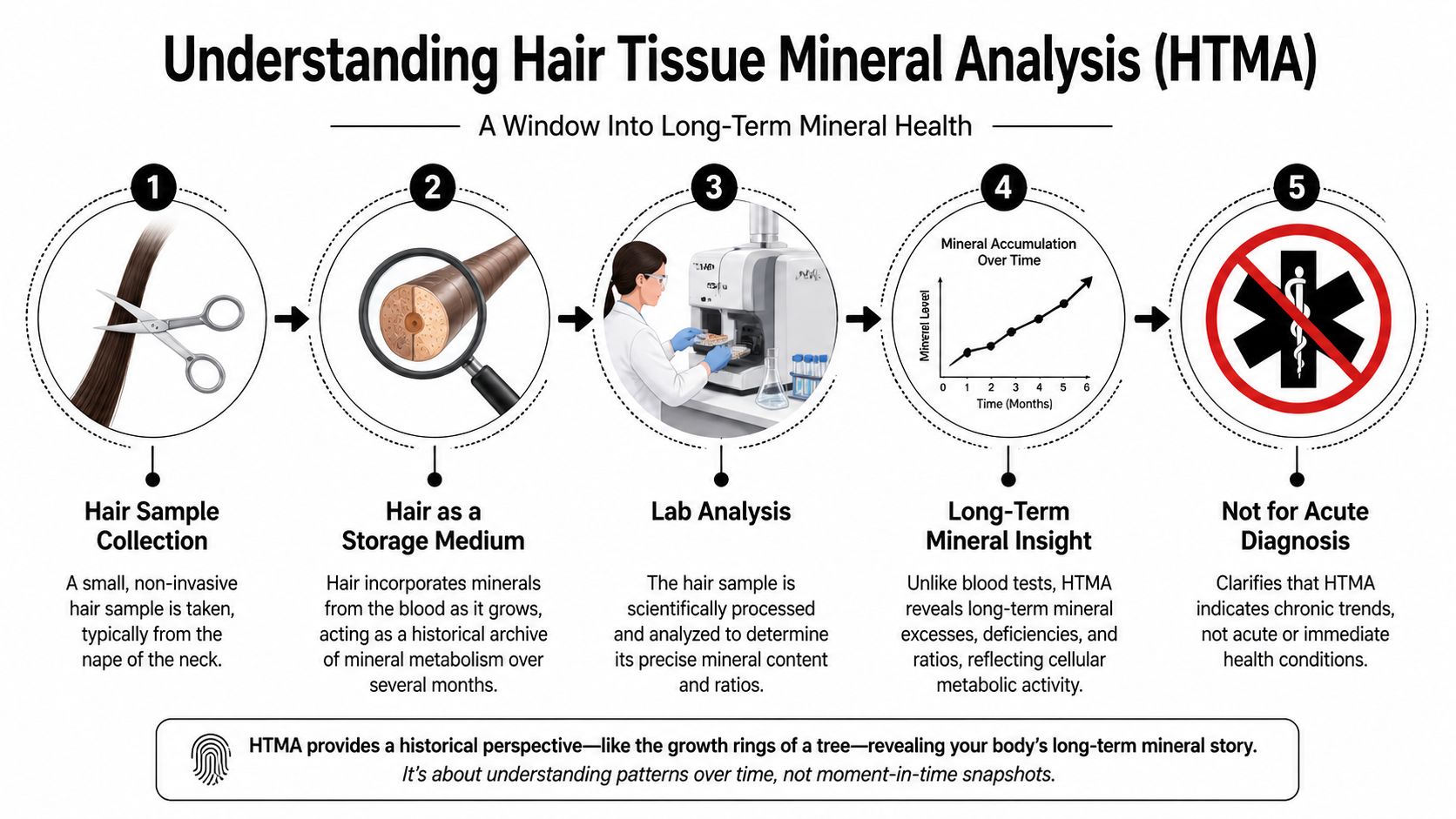
As hair grows, minerals are incorporated into the hair shaft. Once deposited, they remain there as a kind of historical record. That’s why HTMA is often described as a retrospective view of tissue mineral status.
In Australia, hair tissue mineral analysis uses inductively coupled plasma mass spectrometry (ICP-MS) to quantify 20 to 35 minerals and toxic metals, giving a 3 to 4 month retrospective biopsy of tissue mineral deposition that’s less influenced by day-to-day fluctuations seen in blood tests, as described in this ICP-MS overview of HTMA.
What the collection and lab process looks like
The sample itself is simple. A small amount of hair is cut close to the scalp, usually from the nape of the neck. Labs commonly use the portion nearest the scalp because that’s the most recent growth.
From there, the sample goes through laboratory processing rather than consumer gadget analysis. Some descriptions of HTMA note high-temperature preparation and mass spectrometry-based measurement. The important clinical point is that the sample is analysed in a professional laboratory setting, not guessed from a visual inspection or home device.
That distinction matters. When people ask whether hair testing is “real”, they’re often lumping together very different things. A clinical-grade laboratory analysis is not the same as an at-home wellness novelty product.
What kinds of minerals and metals are reviewed
A standard HTMA panel may include:
- Electrolyte minerals such as calcium, magnesium, sodium, potassium, and phosphorus
- Trace minerals such as zinc, copper, selenium, iron, chromium, and manganese
- Toxic metals such as mercury, lead, cadmium, arsenic, aluminium, and nickel
These patterns can be relevant when symptoms include fatigue, poor recovery, stress intolerance, or hair concerns. If hair thinning is one of your symptoms, understanding zinc status may be part of the broader picture, and this guide on an essential mineral for hair growth gives useful background on why zinc matters.
HTMA is designed to identify chronic trends and mineral relationships. It isn’t meant for urgent diagnosis or emergency care.
An Overview of Interpreting Your HTMA Results
You receive your HTMA report, scan the page, and see coloured bars, ratios, and mineral names that sound familiar but do not immediately answer the question you care about. Why do I feel this way, and what should I do next?
An HTMA report is not a simple deficiency checklist. It works more like a map of patterns. The goal is to understand how minerals relate to one another over time, then place those patterns beside symptoms, history, diet, and blood results.
Three parts of the report that matter
Practitioners usually read HTMA in three connected layers:
- Individual mineral levels
- Toxic metal findings
- Mineral ratios
The ratios often deserve the closest attention because physiology depends on balance, not just quantity. A calcium result on its own can be interesting. Calcium in relation to magnesium can be more informative. The same applies to sodium and potassium.

Why ratios can add context
Mineral ratios are used in HTMA to help describe broader functional patterns. The Calcium/Magnesium ratio is commonly discussed in relation to neuromuscular balance and metabolic pace, while the Sodium/Potassium ratio is often reviewed in the context of stress response and recovery patterns. The clinical framework used by many laboratories and practitioners is outlined in reference material from Trace Elements.
That can sound abstract, so it helps to translate it into everyday terms.
- Calcium and magnesium work a bit like the brake and stabiliser systems in the body. If their relationship looks skewed, a practitioner may consider whether the person’s pattern fits sluggish energy, muscle tension, poor stress tolerance, or altered metabolic tempo.
- Sodium and potassium are often reviewed as part of the body’s response to demand. When this ratio is out of range, the question is not “Do the adrenals fail?” but “Does this pattern fit chronic stress, poor resilience, inflammation, or depleted reserve?”
A ratio never diagnoses a condition by itself. It gives context.
How clinicians make sense of the pattern
A careful interpretation usually starts with a practical question. Does this result fit the person sitting in front of me?
That means asking:
- Do the mineral patterns match the symptom history?
- Could toxic metals be interfering with mineral transport or utilisation?
- Are there signs of long-term stress adaptation or altered metabolic balance?
- Could supplements, hair dye, swimming, or workplace exposure have changed the reading?
- What do blood tests show at the same time?
That last question matters more than many people realise.
HTMA and blood testing answer different clinical questions. Hair can suggest longer-term mineral handling and tissue trends. Blood can show what is circulating now, including inflammatory markers, iron studies, thyroid markers, glucose regulation, or immune reactivity. If someone also has bloating, migraines, eczema, joint pain, or post-meal fatigue, pairing HTMA with blood-based testing such as an IgG food reaction panel can help separate overlapping drivers. One test may point toward stress physiology and mineral imbalance. Another may show an immune or inflammatory burden that helps explain why the system is under pressure in the first place.
That is why good interpretation avoids an either-or mindset. The stronger approach is often better together.
A useful HTMA interpretation reads the report as a physiological pattern, then checks that pattern against symptoms and blood-based evidence before any plan is made.
Self-interpreting the chart often leads to oversimplified decisions, such as taking a mineral because it looks low or stopping one because it looks high. A practitioner is looking for relationships, possible confounders, and whether the whole picture makes sense clinically.
HTMA vs Blood Serum Testing A Comparative Analysis
People often ask which is better. The better question is better for what.
A venous blood serum test is still central to healthcare. It’s collected through pathology, processed in a clinical laboratory, and used for medical decisions every day. Blood serum testing is indispensable when you need a current picture of circulating markers. HTMA answers a different kind of question.
Two tests, two timeframes
A low Sodium/Potassium ratio in HTMA is described as a critical indicator of adrenal activity and chronic stress, reflecting mineral accumulation over a three-month period, which contrasts with short-term blood tests that may not show the same pattern until it is more advanced, as noted in this HTMA profile document.
That difference in timeframe is the heart of the comparison.
HTMA vs Venous Blood Serum Testing At a Glance
| Metric | Hair Tissue Mineral Analysis (HTMA) | Venous Blood Serum Test |
|---|---|---|
| Sample type | Hair collected near the scalp | Blood collected by venous draw at a pathology collection site |
| Time window | Longer-term tissue pattern over months | Current serum snapshot |
| Primary strength | Mineral relationships, longer-term deposition, toxic metal screening | Acute assessment, medically actionable current serum findings |
| Best use | Persistent patterns, chronic symptom investigation, metabolic context | Diagnosis support, monitoring current markers, conventional medical work-up |
| Sensitivity to daily fluctuation | Lower | Higher |
| Clinical setting | Interpreted as a complementary tool | Standard pathology framework |
Why they work best together
If someone has chronic bloating, headaches, or fatigue, a practitioner may want both the short-term serum picture and the longer-term tissue picture. That’s especially relevant when symptoms persist despite “normal” routine work-up.
Blood-based testing also has another role that HTMA cannot fill. It can evaluate immune activity and other markers relevant to food-related symptoms using venous blood draws processed through pathology collection and clinical-grade laboratory systems. If you want a clearer view of what serum testing can and can’t reveal, this article on blood tests for vitamins and mineral deficiencies in Australia is a helpful comparison.
A practical way to think about it
Use venous blood serum testing when the question is immediate, diagnostic, or medically urgent. Use hair tissue mineral analysis when the question is whether long-term mineral patterns, toxic metal burden, or ratio imbalances might be contributing to symptoms over time.
One doesn’t cancel out the other.
Clinical Uses and Scientific Limitations of HTMA
A balanced discussion matters here. HTMA can be useful. It also has limits, and patients deserve both sides.
Where HTMA is often clinically useful
HTMA can identify over 30 disease trends before they fully manifest, including the four lows pattern of low sodium, potassium, calcium, and magnesium, and it can screen for heavy metal excesses such as mercury above 0.1 mg%, which are known to disrupt enzyme function and displace essential nutrients like selenium, according to this clinical interpretation document on HTMA patterns.
In practice, clinicians often use HTMA to explore:
- Longer-term mineral imbalance in people with fatigue, poor resilience, and slow recovery
- Heavy metal screening when environmental, occupational, or lifestyle exposure is a concern
- Metabolic pattern assessment such as fast or slow oxidation trends
- Support planning for food, supplement, and lifestyle interventions
For patients with hair changes, skin issues, or fatigue, nutrition often sits in the background of the discussion. This overview of solutions for vitamin deficiency hair loss is useful because it explains how broader nutrient status can influence visible symptoms.
What HTMA cannot do
HTMA is not a standalone diagnostic test for disease. It doesn’t replace a medical assessment, and it shouldn’t be used to rule in or rule out serious conditions on its own.
A few common limitations need to be kept in mind:
- Hair treatments can affect results. Dyeing, bleaching, perming, or certain hair products can alter the sample.
- Interpretation varies. Two practitioners may agree on the data but differ in how aggressively they act on it.
- Validation questions remain. Some aspects of clinical interpretation are still debated, especially when trying to connect a mineral pattern to a specific symptom or diagnosis.
- It is a screening and pattern-recognition tool. It points toward possibilities. It doesn’t replace proper clinical correlation.
The strongest use of HTMA is not certainty. It’s context.
That’s often enough to move a stuck case forward, provided the test is used responsibly.
Integrating HTMA with ImuPro IgG and DAO Testing
For many people, the question isn’t “Should I do HTMA or blood testing?” It’s “Why do I still react to foods, feel inflamed, or struggle with histamine even after changing my diet?”

A better together framework
There is a recognised need to understand how HTMA integrates with IgG or DAO testing, because rising copper/zinc imbalances in Australia and New Zealand can impair gut health and enzyme function, and HTMA’s long-term mineral patterns may help explain why food sensitivities or histamine issues persist, as discussed in this article on mineral relationships and HTMA test ratios.
That combination makes sense clinically.
- IgG blood serum testing can help identify delayed immune reactivity to foods.
- DAO testing can help assess a person’s capacity to break down histamine.
- HTMA can add another layer by showing whether mineral patterns might be undermining gut resilience, stress tolerance, or enzyme function over time.
If you’ve been comparing these tools, this overview of hair mineral analysis versus IgG food sensitivity testing explains the distinction well.
How the pieces connect in practice
Take a patient with bloating, headaches, flushing, and inconsistent reactions to “healthy” foods. An IgG blood serum test may identify foods worth removing temporarily. A DAO result may suggest histamine handling deserves attention. HTMA may then reveal a longer-term mineral pattern that helps explain why the system was vulnerable in the first place.
That doesn’t mean HTMA proves causation. It means it can add useful context.
One option in this category is ImuPro Australia, which offers clinical-grade blood serum IgG testing through pathology collection as well as complementary wellness diagnostics. That model matters because it keeps the blood side of the investigation within a professional collection and laboratory framework rather than relying on casual home alternatives.
A short visual explanation can help if you want to see how these moving parts fit together in a broader health context.
When integration is most useful
This combined approach is often worth discussing when:
- Symptoms are chronic and multi-system, such as gut issues plus skin plus fatigue
- Food elimination has helped only partly
- Histamine intolerance is suspected
- Routine serum work has not fully explained the picture
The aim isn’t to create more testing for its own sake. It’s to reduce guesswork.
Actionable Next Steps and Frequently Asked Questions
If hair tissue mineral analysis sounds relevant, the next step isn’t to treat the report like a diagnosis. It’s to place it inside a proper clinical conversation.
Sensible next steps
A practical pathway often looks like this:
- Start with symptom clarity. Write down your main complaints, how long they’ve been present, and what seems to aggravate them.
- Review your existing pathology. Venous blood serum results still matter and should be part of the picture.
- Choose qualified interpretation. A GP, integrative practitioner, naturopath, or dietitian with experience in functional testing can help prevent overreach.
- Consider lifestyle confounders. Hair products, supplements, and environmental exposures may influence findings.
- Use food and nutrition support alongside testing. If you’re reviewing diet quality while investigating mineral status, this guide to the best hair nutrition food is a practical place to start.
Frequently asked questions
Is HTMA recognised by the TGA in Australia
A key unanswered question for Australian consumers is the lack of region-focused validation data for HTMA accuracy in common symptoms such as bloating and fatigue, along with uncertainty around regulatory status such as TGA recognition and local accreditation pathways, as noted in this discussion of HTMA limitations and Australian confusion points.
The honest answer is that this area can be confusing. HTMA is used in practice, but consumers should ask clear questions about laboratory standards, interpretation method, and how results will be integrated with mainstream clinical information.
How often should retesting be considered
Some HTMA references describe each bar on the report as representing a 90-day tissue average and support retesting at around 3 to 4 months when tracking an intervention. In practical care, retesting only makes sense if the first result changed management and there is a clear reason to review progress.
Can my water supply or environment affect results
Potentially, yes. Environmental exposure is one reason some people consider HTMA in the first place. Water source, workplace exposure, air quality, and personal care products can all become part of the interpretation discussion.
Is HTMA enough on its own
Usually, no. It’s most useful when paired with symptom history, diet review, relevant pathology, and clinical judgement.
If you’re dealing with persistent bloating, skin flare-ups, headaches, fatigue, or food-related symptoms that haven’t been fully explained, ImuPro Australia offers clinical-grade blood serum IgG and DAO testing collected through pathology centres, with complementary wellness diagnostics that can be discussed as part of a broader, evidence-aware assessment.