
If you're battling persistent symptoms like bloating, fatigue, or skin problems, you’ve probably wondered if a food reaction is to blame. An allergy and intolerance test can seem like the logical next step, but choosing the right one is where things get tricky. The most important thing to grasp is that a true, immediate allergy and a delayed food intolerance are entirely different biological processes, and they cannot be diagnosed with the same test.
Why Is Finding the Right Test So Confusing?
Trying to find a reliable test when you're already feeling unwell can be completely overwhelming. You're certainly not alone; it's estimated that adverse food reactions affect a staggering 20% of people in Western countries like Australia. While classic food allergies are less common, countless people are left dealing with chronic symptoms that standard medical tests just don't seem to explain.
The real confusion starts with the mix-up between a food allergy and a food intolerance. They are not the same thing.
True Allergies (IgE-mediated): These are the fast and sometimes severe reactions of your immune system. Think of someone eating a peanut and immediately breaking out in hives or struggling to breathe. This is an immediate, IgE antibody response.
Food Intolerances (often IgG-mediated): This is a much slower, inflammatory reaction. The symptoms—like headaches, brain fog, or digestive issues—can appear hours or even days after you’ve eaten the offending food. This delay makes it almost impossible to pinpoint the culprit on your own.
This is exactly why the quality of your test matters so much. Many of the at-home wellness kits you see online simply do not have the scientific backing to give you a reliable answer. To get clear, actionable results, you need a method that is grounded in clinical science.
The most accurate and dependable results come from Clinical-Grade Testing performed on a blood serum sample. This requires a professional venous blood draw at a Pathology Collection centre, ensuring the sample's integrity for superior accuracy compared to home-test alternatives.
This professional process is what separates a serious diagnostic tool from a simple wellness product. When you choose a pathology-based allergy and intolerance test like ImuPro, you’re ensuring your results are built on the highest scientific standards. This is absolutely critical, especially with so many low-quality food intolerance tests on the market that can lead you down the wrong path.
By starting with a medically validated test, you can finally move past the confusion and turn your frustrating symptoms into a clear roadmap for getting well.
The Science Behind Allergies and Intolerances
To get to the bottom of which test you might need, it’s crucial to understand how your body can react to food. We're talking about two very different biological pathways: a true food allergy and a delayed food intolerance. Getting these two mixed up is a common source of confusion and often leads to ineffective attempts at managing symptoms.
Think of your immune system as a highly alert security detail. A true food allergy is like this team mistaking a harmless protein, say from a peanut, as a major threat and triggering an immediate, all-out emergency response.
A food intolerance, however, is a much quieter, more drawn-out affair. It’s less like a blaring alarm and more like a slow, inflammatory process in the background. The reaction builds over hours or even days, which makes it incredibly difficult to connect your symptoms to a specific meal you ate.
The Allergic Response (IgE-Mediated)
A classic food allergy is an immune system event driven by antibodies called Immunoglobulin E (IgE). When you eat a food you're allergic to, your body flags it as an invader and produces specific IgE antibodies. These antibodies latch onto immune cells known as mast cells, which then release a flood of histamine and other chemicals, causing an immediate reaction.
The symptoms are often unmistakable, ranging from hives and swelling to, in severe cases, life-threatening anaphylaxis. Because this response is so fast—usually showing up within minutes to two hours—it's often much easier to pinpoint the culprit food.
The Intolerance Response (IgG-Mediated)
A food intolerance often involves a different kind of antibody: Immunoglobulin G (IgG). In this scenario, when you eat a food your body has a sensitivity to, IgG antibodies can bind with the food proteins to form immune complexes. These complexes can trigger a low-grade inflammatory process.
The key difference here is the timing. Unlike an immediate IgE allergic reaction, these IgG-mediated inflammatory symptoms can be delayed by up to 72 hours. This makes trying to diagnose it yourself a near-impossible guessing game without a proper blood analysis.
This significant delay is why food intolerances are so often linked to those chronic, nagging symptoms that seem to come out of nowhere—things like persistent bloating, brain fog, headaches, fatigue, and even skin issues like eczema or acne.
The chart below gives you a clearer visual on how these two responses stack up.
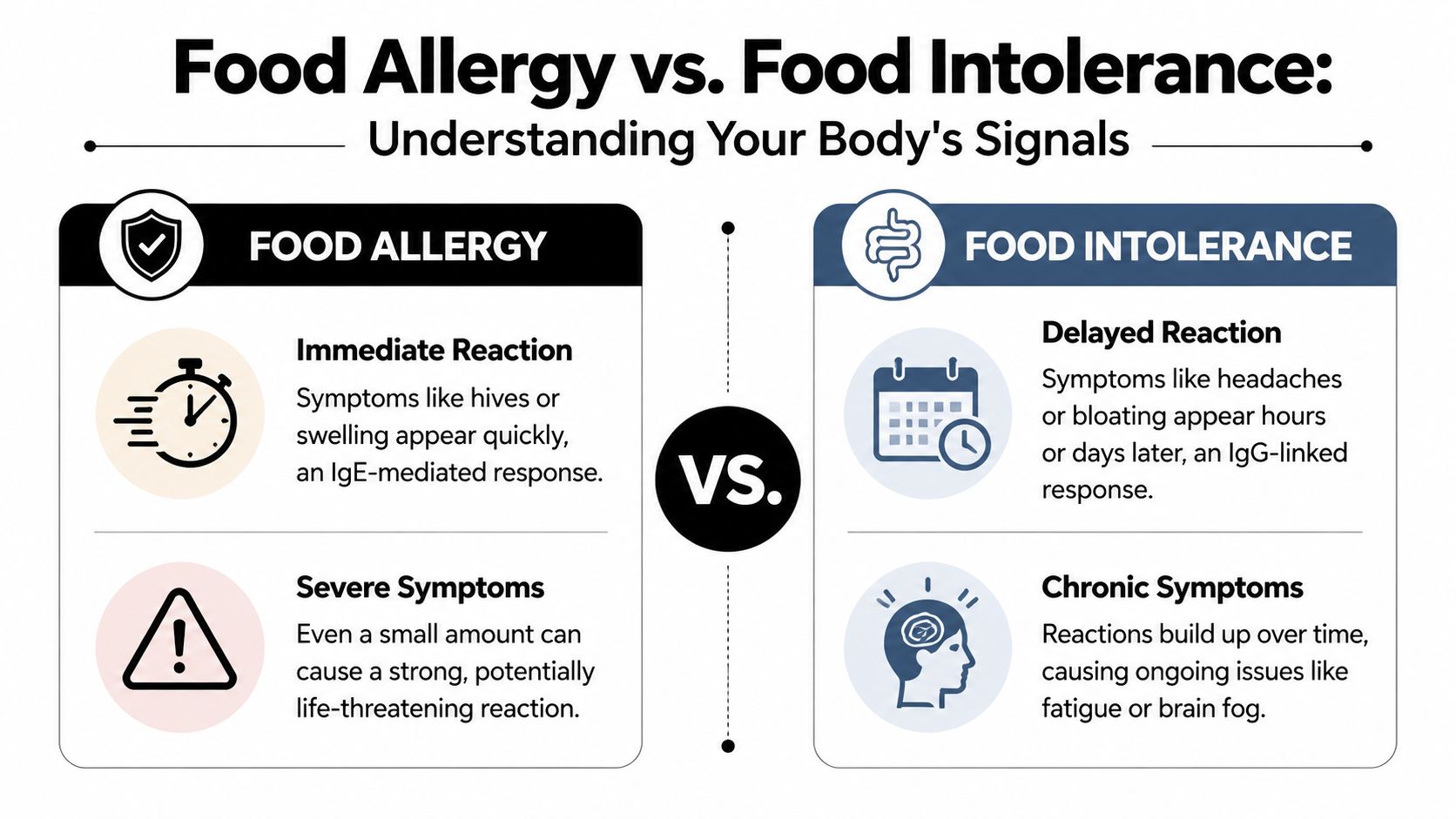
To put it all into perspective, this table breaks down the core differences between an immediate IgE-mediated allergy and a delayed IgG-mediated intolerance.
Food Allergy (IgE) vs. Food Intolerance (IgG-Mediated)
| Characteristic | Food Allergy (IgE-Mediated) | Food Intolerance (IgG-Mediated) |
|---|---|---|
| Immune Cell | Immunoglobulin E (IgE) | Immunoglobulin G (IgG) |
| Reaction Time | Immediate (minutes to 2 hours) | Delayed (up to 72 hours) |
| Symptoms | Hives, swelling, itching, difficulty breathing, anaphylaxis | Bloating, brain fog, fatigue, headaches, joint pain, eczema |
| Identification | Often obvious due to rapid onset | Very difficult to identify without testing |
| Mechanism | Histamine release from mast cells | Formation of inflammatory immune complexes |
Understanding these distinct pathways is the first step toward finding the right answers for your health.
While testing helps pinpoint specific food triggers, remember that managing your broader environment is also a huge piece of the puzzle. For example, using the best HVAC filters for allergies can make a real difference to your symptom load by improving indoor air quality.
By grasping these scientific differences, you can start to see why a Clinical-Grade IgG food intolerance test, which analyses a blood serum sample, is specifically designed to uncover these hidden, delayed reactions.
Understanding Clinical-Grade Blood Testing Methods
When you're trying to get to the bottom of food-related symptoms, you need answers you can trust. Not all allergy and intolerance tests are created equal, and the accuracy of your results hinges entirely on the quality of the test itself. For reliable, clinically relevant insights, the process starts with one non-negotiable: a venous blood draw.

Having your blood drawn by a professional at a Pathology Collection centre is the gold standard for a reason. This method provides a clean, ample sample of blood serum—the component needed for analysis. It guarantees the sample is free from contamination, correctly handled, and stable enough for transport to the lab.
Put simply, this clinical approach ensures the integrity of the sample, which is the foundation for any precise and dependable lab result. This process provides superior accuracy compared to home-test alternatives.
The Power of Clinical-Grade Lab Analysis
Once your sample arrives at a certified laboratory, the investigation begins. The most trusted and validated technology used for this analysis is the ELISA (Enzyme-Linked Immunosorbent Assay) method. Think of it as a highly sensitive detection system designed to precisely measure the concentration of specific antibodies in your blood serum.
This is where we distinguish between a true allergy and a delayed intolerance. For food intolerances, the test is looking for IgG antibodies, whereas for classic allergies, it measures IgE antibodies.
IgG Food Intolerance Test: This test identifies IgG antibodies to a range of foods from a blood serum sample. A high concentration of these antibodies can point to an inflammatory response to a certain food, helping to finally connect the dots with those delayed reactions that cause chronic symptoms.
IgE Allergy Test: This is the blood test doctors use to diagnose immediate, true food allergies. It detects IgE antibodies linked to specific allergens, which are responsible for the rapid-onset reactions most people associate with the word "allergy."
It’s this combination—a professional venous blood draw plus advanced ELISA analysis—that creates a robust framework for investigating your symptoms. This rigorous process is the very cornerstone of the ImuPro testing methodology, which focuses on blood serum analysis. Its Clinical-Grade lab processing makes it a diagnostic tool, not just a wellness product.
Specialised Testing for Histamine Intolerance
Sometimes, your symptoms might not be driven by a classic IgG or IgE reaction. The culprit could be an issue with histamine metabolism. This is what we call histamine intolerance, and it often happens when your body can’t properly break down histamine from the foods you eat. This is usually due to a deficiency in a crucial enzyme: Diamine Oxidase (DAO).
To check for this, a specific blood test can measure the activity level of the DAO enzyme in your blood serum. If the levels are low, it's a strong indicator that histamine intolerance is the reason behind symptoms like headaches, skin flushing, or digestive issues.
This specialised test, also performed on a professionally collected blood serum sample, adds another critical layer to the diagnostic puzzle. It allows for a far more targeted approach, ensuring you’re investigating the right biological pathway for your unique symptoms. This commitment to validated, scientific methods defines a superior allergy and intolerance test.
The ImuPro Process: From Blood Draw to Action Plan
Deciding to get a Clinical-Grade test is a significant first step. The next is understanding what actually happens from the moment you decide to go ahead, to when you have an action plan in your hands.
The ImuPro journey isn't another wellness trend; it's a structured and scientifically solid process. We’ve designed it to turn a simple blood serum sample into a powerful tool for your health, giving you the confidence to finally move forward.
It all hinges on clinical accuracy and professional oversight from start to finish, which truly sets it apart from many at-home test kits.
Step 1: Professional Venous Blood Draw
Your journey starts when you choose the right ImuPro test panel for you. From there, you will visit a partner Pathology Collection centre for a professional venous blood draw. This is a non-negotiable first step, and for good reason.
A trained phlebotomist collects your blood, ensuring we get a high-quality, stable blood serum sample. This critical step removes the risk of contamination or sample degradation that can plague other collection methods, guaranteeing your sample is in optimal condition for analysis.
Step 2: Clinical-Grade Laboratory Analysis
Once collected, your blood serum is sent securely to our ISO-certified laboratories in Germany. This is where the real work begins. Your sample is tested using the medically validated ELISA (Enzyme-Linked Immunosorbent Assay) technology.
This highly sensitive method allows us to precisely measure specific IgG antibodies against an array of different foods. The combination of a clean blood serum sample and powerful ELISA technology is the cornerstone of the ImuPro process. It’s how we ensure the highest level of accuracy and reproducibility in your results, making it a superior allergy and intolerance test option.
The ImuPro testing method is designed to give you more than just data; it provides genuine clinical insight. By sticking to strict Pathology Collection and validated lab analysis of a blood serum sample, the process delivers a level of precision you simply can’t get from a commercial wellness kit.
Step 3: From Raw Data to an Actionable Toolkit
Your analysis is usually complete within 10-20 business days. But you won't just get a spreadsheet of confusing numbers. Instead, your results are compiled into a comprehensive, personalised report. This document clearly details your specific IgG reactivities to all the foods we tested.
More importantly, the report comes with an individualised dietary guide and a detailed recipe book. This is what turns complex scientific data into a practical, easy-to-follow plan tailored to your unique body. It’s a clear roadmap for the elimination and rotation phases, empowering you to take back control of your diet and, ultimately, your health.
You can learn more about the specifics of the ImuPro test method and the rigorous standards behind it.
How to Interpret and Use Your Test Results
So, you've got your ImuPro report in hand. What now? It’s tempting to see this detailed document as the finish line, but it’s actually the starting line. Think of it as your personalised roadmap, moving you away from guesswork and towards a targeted plan for feeling better.
The report shows you which foods your immune system is reacting to, and by how much. Foods with a high IgG reactivity are likely contributing to the inflammation that may be causing your symptoms. The goal isn't to banish these foods from your life forever, but to use this knowledge strategically to give your system a much-needed break.

The Elimination and Rotation Strategy
The most effective way to use your results is with a structured, three-phase approach. This isn't about restriction; it's about systematically calming inflammation and figuring out your body's unique thresholds.
The Elimination Phase: First, you'll temporarily remove the foods that showed high IgG reactivity. This gives your immune system a rest from constant triggers and allows your gut lining to begin its recovery process. Many people start to feel a real difference in their symptoms during this phase.
The Rotation Phase: While you’re avoiding the reactive foods, you’ll follow a rotation diet with all the foods you can eat. This simply means not eating the same things every single day. It helps prevent you from developing new sensitivities and ensures you’re getting a wide variety of nutrients.
The Reintroduction Phase: After the initial break, you'll carefully and methodically reintroduce the avoided foods, one by one. This is a crucial step. It’s where you turn the data from your report into real-world knowledge about what your body can and can’t handle.
A key skill to master during this process is learning to understand nutrition labels. It's the only way to be sure you're truly avoiding hidden trigger ingredients in packaged foods, especially during the elimination phase.
Your IgG test results are not a lifelong sentence. Clinical observations indicate that by removing trigger foods and supporting gut health, IgG reactivities can decrease over time, often allowing for the reintroduction of many foods without symptoms.
Partnering with a Healthcare Practitioner
While the ImuPro report is designed to be straightforward, putting it into practice can feel overwhelming. Creating a balanced, sustainable plan is much easier—and safer—when you work with a qualified healthcare practitioner.
A professional can help you navigate the elimination and reintroduction phases, making sure you don't miss out on vital nutrients along the way. They’ll offer personalised advice, help you track your progress, and interpret your body’s responses as you reintroduce foods.
This kind of partnership is invaluable for turning the insights from your allergy and intolerance test into lasting health improvements.
Looking Beyond IgG: Histamine and DAO Testing
So you’ve investigated IgG reactivities, but you're still chasing answers. If you’re dealing with frustrating symptoms like headaches, skin flushing, hives, or digestive upset that feel like an allergy but don't seem to have a clear food trigger, there might be a different mechanism at work: histamine intolerance.
This isn't a true food allergy. Think of it more as a "traffic jam" in your body. Histamine is a chemical that’s naturally in many foods, and your body also makes it. Normally, an enzyme called Diamine Oxidase (DAO) acts like a traffic controller, breaking down histamine from your food and keeping things flowing smoothly.
But what happens if that traffic controller isn't functioning optimally? If your DAO enzyme activity is low, you can’t clear histamine from your system efficiently. It builds up and can trigger a host of allergy-like symptoms after you eat histamine-rich foods like aged cheese, fermented foods, or red wine.
Pinpointing the Problem with a DAO Test
Because the symptoms of histamine intolerance look so much like food allergies and IgG sensitivities, trying to guess what’s going on is a recipe for frustration. To get a real answer, you need a test that specifically measures your DAO enzyme function. This requires a professional venous blood draw to ensure the blood serum sample is stable and the results are precise.
The ImuPro DAO test is a specialised diagnostic tool designed to do exactly that. It analyses your blood serum to determine the activity level of your DAO enzyme.
A low DAO level provides a direct, scientific explanation for symptoms. It confirms your body’s ability to break down dietary histamine is compromised, which gives you a clear path forward: managing your condition with a targeted, low-histamine diet.
This Clinical-Grade test offers a vital piece of the diagnostic puzzle, especially for those whose symptoms just don't fit neatly into the IgG or IgE box. It moves beyond just looking at foods and gets to the heart of a key metabolic process.
If you’re looking for more clarity, you can learn how to test for histamine intolerance and what the results really mean for your daily life.
Common Questions About Testing
It’s completely natural to have questions when you’re trying to get to the bottom of chronic symptoms. Getting clear, reliable answers is the whole point of testing, so let's tackle some of the most common queries.
Why Is a Venous Blood Draw Essential for an IgG Test?
For accuracy you can depend on, nothing beats a venous blood draw performed at a proper Pathology Collection centre. This is the only method that provides a pure, stable blood serum sample, which is what is required for sensitive lab analysis.
Other collection methods are prone to issues like contamination or insufficient sample volume, which can compromise the results. A professional venous blood draw eliminates this uncertainty, providing superior accuracy.
Think of it like this: if you were building a precision instrument, you would start with the highest-quality materials. A venous blood draw ensures we're working with the purest "ingredients" from the very start, giving you a result you can actually trust.
What Do I Do After I Get My ImuPro Results?
Your results are your roadmap. The first step is to follow the "elimination and rotation" plan outlined in your personalised ImuPro report. This involves temporarily avoiding foods that showed a high IgG reaction. This gives your body a break and helps calm inflammation.
Later, you'll reintroduce these foods one by one to see how your body responds. We always recommend doing this with the support of a healthcare practitioner, who can help you fine-tune the plan for the best possible outcome.
Will My Food Reactivities Last Forever?
Not necessarily, and that's the encouraging part. IgG food reactivities are not usually a life sentence. Clinical observations suggest they are often tied to gut health.
When you follow the elimination plan based on your ImuPro results, you're not just avoiding trigger foods; you're giving your gut lining a chance to heal and repair. As your gut health improves, many people find they can successfully reintroduce foods they once reacted to without issues.
Ready to move from frustrating symptoms to clear answers? ImuPro Australia provides Clinical-Grade IgG food intolerance testing based on professional Pathology Collection and medically validated lab analysis of blood serum.
Find the right ImuPro test for you and start your journey towards better health.